SIGNIFICANCE OF THE ELECTRICAL LOAD IN THE UTILIZATION PHASE
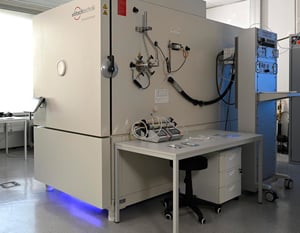
Vehicles are exposed to extreme conditions during the use phase. Temperature fluctuations, vibrations, humidity and electromagnetic interference affect the performance and longevity of individual components. Precise simulation of these loads makes it possible to identify potential failures at an early stage and increase product reliability.
The simulation of electrical stress over the life cycle of vehicle components is crucial for OEMs and suppliers to ensure the reliability and safety of their products. As a testing service provider, we offer specialized solutions to address the challenges and requirements in the critical use phase of individual components.

- 01 Ambient conditions
- 02 Vibrations and mechanical loads
Ambient conditions
Various standards, such as VW 80000 or LV124,specify which climatic conditions must be taken into account during the tests. This includes extreme temperatures and high humidity, which affect the electrical properties of the components.
Vibrations and mechanical loads
Technologies and methods for simulation
TECHNOLOGIES AND METHODS FOR SIMULATION
In order to realistically simulate the electrical loads and meet the corresponding requirements, we rely on state-of-the-art technologies and test methods :
- Multiphysics simulation: this technology enables the simultaneous consideration of electrical, thermal and mechanical phenomena. This is crucial in order to understand the complex interactions and meet the standard requirements.
- Service life modeling: By using service life models, we can predict the expected service life of components under realistic operating conditions, which also takes into account the requirements of the standard.
- Cyclic load tests: These tests simulate the repeated loads that components experience in vehicle operation and are important for identifying potential weak points in the design at an early stage.
The implementation of electrical load simulations offers numerous advantages:
- Early identification of weak points: Simulation allows potential problems to be identified early before they occur in real-world use. This helps to avoid costly recalls and repairs.
- Optimization of product reliability: The analysis of simulation results enables targeted adjustments that increase the service life and performance of the products.
- Compliance with standards: Our tests ensure conformity with current standards, guaranteeing product quality and safety.
- Cost efficiency: By reducing the need for extensive physical testing, development costs can be lowered while product quality is improved.
EMISSIONS & ODOR
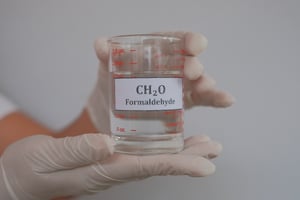
Formaldehyd in Fahrzeugen: Herausforderungen für die Automobilindustrie
Read moreStellantis: Freigabe für Emissionsprüfungen erfolgreich (VIAQ)
Read moreVDA 277 vs. VDA 278: Was ist der Unterschied?
Read moreGeruchsunterschiede bei Polypropylen: Die Rolle von Faserverstärkung und Verarbeitungsparametern
Read moreWarum sind die Einheiten der Ergebnisse von Prüfungen der Werkstoffemissionen eigentlich so unterschiedlich?
Read moreGrenzwerte für Formaldehyd und Formaldehydabspaltern in Fahrzeugen
Read moreFREQUENTLY ASKED QUESTIONS ABOUT SERVICE LIFE TESTING
- Early identification of weak points
- Optimization of product reliability
- Compliance with standards
- Cost efficiency