
AIRBAG TESTING LAB
FOR RELIABLE VALIDATION AND DEPLOYMENT PERFORMANCE
Validate critical restraint components with a test program built around your product, specification, and development timeline.
imat supports automotive OEMs, Tier 1 and Tier 2 suppliers, airbag manufacturers, textile producers, and interior component developers with comprehensive airbag validation services for US and global vehicle programs.
Our airbag testing lab can support material evaluations, environmental conditioning, module testing, system integration, deployment analysis, occupant classification, production verification, and controlled sample disposition. Every program is developed around the applicable component, installation environment, test specification, and acceptance criteria.
A2LA-accredited laboratory network
More than 30 years of automotive testing expertise

COMPREHENSIVE AIRBAG
TESTING SERVICES
Airbag Module Testing
Airbag module testing evaluates the performance of a complete module under defined installation, environmental, and activation conditions.
Programs may be developed for driver, front passenger, side, curtain, knee, seat-mounted, and other inflatable restraint modules. Depending on the specification, the test scope may include environmental preconditioning, electrical checks, deployment timing, cover opening, cushion inflation, component retention, visual inspection, and post-deployment analysis.
Testing can also be used to compare different material combinations, manufacturing processes, inflator configurations, cover designs, or module revisions.
Typical objectives include:
- Verifying deployment after environmental conditioning
- Evaluating cushion opening and inflation behavior
- Identifying tears, fragments, or component separation
- Comparing prototype and production configurations
- Investigating failed or nonconforming modules
- Documenting design or manufacturing changes
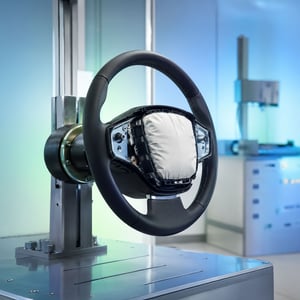
AIRBAG SYSTEM TESTING
Airbag system testing examines how the module interacts with other restraint and vehicle components.
The test setup can include the airbag module, inflator, cushion, sensors, control logic, wiring, occupant classification functions, seat position inputs, instrument panel, steering wheel, seat structure, door trim, or headliner components, depending on the required scope.
Representative installation geometry and defined trigger conditions can help identify integration issues that may not be visible during isolated component testing.
A system-level program may evaluate:
- Module and trim interaction
- Tear-seam opening behavior
- Sensor and electrical interfaces
- Occupant classification inputs
- Deployment logic and triggering conditions
- Interference with surrounding components
- Performance after temperature, humidity, vibration, or aging exposure
The result is a clearer understanding of the complete restraint-system behavior before vehicle-level validation.

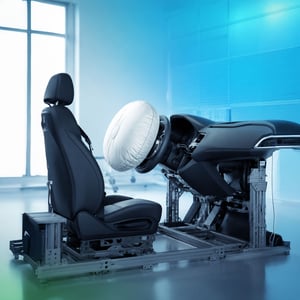
AIRBAG DEPLOYMENT TESTING
Airbag deployment testing captures how an airbag module opens, inflates, and interacts with its surrounding environment.
Depending on the test plan, instrumentation may include high-speed video, synchronized electrical measurements, pressure data, timing references, displacement measurements, temperature monitoring, and detailed post-deployment inspection.
Deployment evaluations can help engineering teams assess:
- Initial activation and opening sequence
- Cushion emergence and unfolding
- Inflation timing and stability
- Cover-door and tear-seam behavior
- Contact with instrument panel or trim components
- Fragmentation or material separation
- Cushion tears, seam failures, or abnormal venting
- Differences between conditioned and unconditioned samples
Test conditions can be tailored to the applicable module, specification, installation position, and program objective.
AIRBAG FABRIC TESTING
Airbag fabric testing supports the development and validation of coated and uncoated cushion materials, seams, sewing threads, and related textile components.
Programs may combine environmental conditioning with physical property testing before and after aging. Depending on the applicable specification, evaluations may address:
- Tensile and tear properties
- Seam performance
- Fabric weight and thickness
- Static or dynamic air permeability
- Coating behavior
- Dimensional stability
- Heat and humidity aging
- Ozone or cyclic conditioning
- Visual changes and material degradation
Where required, ASTM D5427 conditioning can be incorporated as a preparatory accelerated-aging step before subsequent fabric-property testing.
By evaluating both initial properties and retained performance after conditioning, manufacturers can better understand how the cushion material may respond throughout the intended product life.
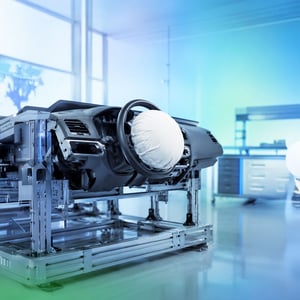
AIRBAG OCCUPANCY TESTING
Airbag occupancy testing supports the evaluation of occupant detection, occupant classification, suppression, and deployment decision functions.
The program can be configured around defined seat loads, occupant representations, child restraint conditions, seating positions, seat-track settings, belt conditions, and repeated classification cycles.
Depending on the system and specification, testing may address:
- Empty-seat recognition
- Adult occupant classification
- Small occupant classification
- Child restraint detection
- Airbag suppression logic
- Seat-position inputs
- Repeatability and classification stability
- Behavior following environmental conditioning
- Communication between the seat, sensors, and restraint controller
For US vehicle programs, the scope should clearly distinguish component-level development testing from formal vehicle-level regulatory compliance testing.

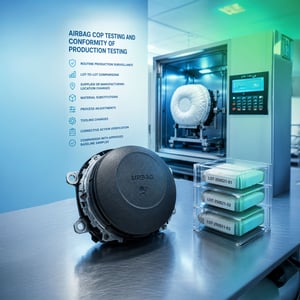
AIRBAG COP TESTING AND
CONFORMITY OF
PRODUCTION TESTING
Airbag CoP testing, also known as airbag conformity of production testing, helps verify that production parts continue to meet approved requirements.
A CoP program can use defined sampling intervals, reference configurations, environmental conditioning, material checks, deployment evaluations, and trend analysis to identify changes in production performance.
Testing may support:
- Routine production surveillance
- Lot-to-lot comparisons
- Supplier or manufacturing-location changes
- Material substitutions
- Process adjustments
- Tooling changes
- Corrective action verification
- Comparison with approved baseline samples
Results can be organized by production lot, part number, revision level, manufacturing date, sample condition, and applicable acceptance criteria.
AIRBAG DISPOSAL TESTING
Airbag disposal testing provides a controlled and documented process for prototype modules, aged samples, nonconforming units, development hardware, and test-complete components that require deployment or deactivation before final disposition.
Because airbag modules contain energetic components, the acceptance and handling process must be reviewed before samples are shipped or delivered.
A project-specific disposal program may include:
- Sample identification and inventory
- Review of module condition
- Controlled deployment or deactivation
- Documentation of the disposition process
- Post-deployment inspection
- Segregation of remaining materials
- Final test or disposal records
Transportation, storage, activation, and disposal requirements must be agreed upon in advance and handled according to applicable procedures and regulations.

BIG GOALS.
STRONG PARTNERS.
WITH US, VISION BECOMES REALITY.
The silent force behind safe mobility
At imat, we don't just test - we protect, strengthen and ensure the quality of your components.
With state-of-the-art testing technology, international accreditation and in-depth expertise, we are the
the invisible force behind reliable performance.
TRUSTED BY AUTOMOTIVE LEADING INDUSTRY
Blank text accreditations/certifications/test standards. Automobile manufacturers worldwide such as Volkswagen, Mercedes-Benz, BMW, Porsche, Tesla & Co. as well as suppliers trust in our expertise and reliability.






AIRBAG TESTING FOR US
AUTOMOTIVE PROGRAMS
US-based engineering, quality, sourcing, and manufacturing teams need clearly defined test scopes and results that can be reviewed across multiple departments and locations. Our project workflow is designed to provide a clear line of sight from the initial requirement to the final data package.
Depending on the agreed scope, project documentation can include:
- Test plan and sample matrix
- Applicable specification and revision
- Sample identification and traceability
- Conditioning and setup information
- Test configuration photographs
- High-speed deployment images
- Recorded measurement data
- Post-test observations
- Deviations from the agreed method
- Comparison with acceptance criteria
- Engineering summary and conclusions
English-language reports can be structured around customer requirement numbers, part numbers, design revisions, production lots, and validation milestones.


Exposure tests give us the opportunity to make the future measurable. Because sustainable quality begins where products not only impress today, but also stand the test of time tomorrow.

WHY WORK WITH IMAT
Test Plans Built Around Your Specification
The scope is aligned with the applicable document revision, component configuration, and engineering objective rather than relying on a generic test package.
Material-to-System Perspective
Testing can connect fabric and material properties with cover behavior, module deployment, occupancy functions, and production consistency.
Traceable Documentation
Sample identification, test conditions, setup information, measurements, images, and observations are organized into a reviewable results package.
Engineering-Focused Communication
Potential anomalies and deviations can be discussed before the project is closed, helping your team understand the results and determine the next step.
Support From Development Through Production
Programs can be structured for prototypes, validation samples, production parts, supplier changes, CoP requirements, and failure investigations.
READY TO LOOK TO THE FUTURE?
Artificial exposure is more than just a laboratory test.
It is a controlled look into the future of your vehicles and components long before they hit the road. With our "superpower" of time acceleration, we help you make better decisions and develop long-lasting quality.
Talk to us about customized exposure and aging tests for your needs.

NORM CONFORM. CLEAR. RELIABLE.
TESTS ACCORDING TO GLOBAL STANDARDS.
Our validation follows the standards that stand for safety, quality and reliability worldwide.
DIN, ISO, VDA and OEM specifications determine our testing processes - transparently documented and consistently compliant with standards.
Because the highest standards are the basis for lasting results.






BIG GOALS.
STRONG PARTNERS.
FULL SPEED AHEAD TO THE OVERALL PORTFOLIO.
The silent force behind safe mobility
At imat, we don't just test - we protect, strengthen and ensure the quality of your components.
With state-of-the-art testing technology, international accreditation and in-depth expertise,
we are the invisible force behind reliable performance.
TESTED QUALITY - YOUR ADVANTAGE THROUGH TRUST:
- Safety - reliable materials and systems
- Compliance - fulfillment of standards, laws & OEM specifications
- Competitiveness - quality, durability and comfort as selling points
Our promise to you
We support companies along the supply chain in making materials, components and vehicles safe, sustainable and ready for series production for the mobility of the future. To this end, we offer independent testing and expert advice - backed by over 35 years of experience and a deep understanding of our customers' challenges. With a global presence, we support projects in all relevant markets, combine international standards with regional requirements and thus create real added value locally. imat services combine maximum reliability, efficient processes and market-driven prices with technical excellence.
Together, we create trust in innovative mobility solutions and make a measurable contribution to economic efficiency and ecological responsibility.
BIG GOALS.
STRONG PARTNERS.
FULL THROTTLE TO THE COMPLETE PORTFOLIO.
The silent force behind safe mobility
At imat, we don't just test - we protect, strengthen and ensure the quality of your components. With state-of-the-art testing technology, international accreditation and in-depth expertise, we are the invisible force behind reliable performance.